
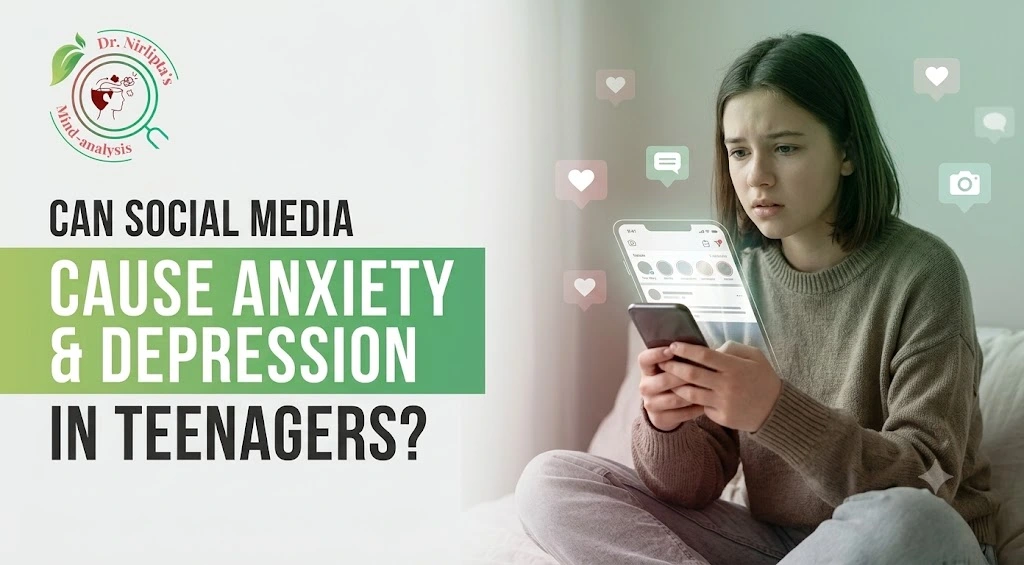
Social media has become a normal part of teenage life, but many parents wonder: can social media cause anxiety and depression in teenagers? Current research suggests that social media use—particularly problematic or excessive use—can be associated with anxiety, depressive symptoms, sleep problems, social comparison, and reduced emotional wellbeing. However, social media is rarely the only factor involved.
A teenager’s mental health can also be influenced by family relationships, academic pressure, bullying, genetics, existing anxiety or depression, sleep, physical activity, and offline friendships. Therefore, it is more accurate to view social media as one possible influence rather than assuming it directly causes a mental health disorder in every teenager.
How Social Media Influences Teenage Mental Health
Adolescence is an important period for emotional, social, and psychological development. WHO notes that anxiety and depression are among the leading causes of illness and disability among adolescents.
Social media can provide genuine benefits. Teenagers may use it to maintain friendships, find communities, express themselves, learn new skills, access information, or seek peer support.
The concern arises when the way social media is used begins to interfere with sleep, schoolwork, physical activity, relationships, or emotional wellbeing.
Research reviews have found associations between problematic social media use and symptoms of anxiety and depression in adolescents and young adults. Importantly, these studies generally show associations rather than proof that social media alone causes mental illness.
Social Comparison and Self-Esteem
Social media often presents carefully selected images of appearance, lifestyle, achievements, friendships, and experiences.
Teenagers may compare their ordinary daily lives with highly edited or selectively presented online content. This can contribute to feelings of inadequacy, body dissatisfaction, low self-esteem, or fear that others are doing better.
The American Psychological Association specifically recommends limiting social-media use for appearance-based social comparison because research has linked these patterns with poorer body image and depressive symptoms, particularly among girls.
Fear of Missing Out (FOMO)
Seeing friends attending events, travelling, socialising, or receiving attention online can create fear of missing out, commonly called FOMO.
A teenager may repeatedly check notifications, stories, messages, or posts because they are worried about missing something important.
This constant checking can create a cycle:
FOMO → repeated checking → temporary reassurance → new comparison or worry → more checking
For some teenagers, this pattern can contribute to emotional stress and difficulty disconnecting.
Sleep Disruption
Late-night scrolling, messaging, notifications, or watching short-form videos can delay bedtime and interfere with sleep.
Sleep is particularly important during adolescence. Research has identified relationships between problematic social media use, sleep problems, anxiety, depression, and wellbeing.
The APA also recommends that social media use should not interfere with adolescent sleep or physical activity.
Cyberbullying and Online Harassment
Cyberbullying can be especially distressing because harmful comments, images, rumours, or messages can follow a teenager beyond the school environment.
A teenager experiencing online harassment may become anxious about checking their phone, avoid school or friends, withdraw socially, or experience changes in mood and sleep.
Online discrimination, cyberhate, and bullying have also been associated with increased anxiety and depressive symptoms in adolescents.
Can Social Media Cause Anxiety and Depression?
The most accurate answer is: social media may contribute to or worsen anxiety and depressive symptoms in some teenagers, but it should not automatically be considered the sole cause.
A 2022 systematic review and meta-analysis found statistically significant associations between problematic social media use and depression, anxiety, and stress among adolescents and young adults.
A more recent systematic review examining children and adolescents found that problematic social media use was associated with depressive and anxiety symptoms. It also identified sleep deprivation, social comparison, feedback-seeking, social support, exercise, and the type of social media use as factors that may influence the relationship.
This distinction matters because a teenager who develops anxiety after using social media may not necessarily have an anxiety disorder.
For example, occasional sadness after seeing an upsetting post is different from persistent anxiety that interferes with school, friendships, sleep, or everyday functioning.
Likewise, feeling disappointed after receiving few likes is not automatically depression. Depression involves a broader pattern of symptoms and functional difficulties that should be assessed by a qualified professional.
Signs That Social Media May Be Affecting Your Teenager
Parents should pay attention to patterns and changes in functioning, rather than focusing only on the number of hours a teenager spends online.
Possible warning signs include:
- Becoming unusually anxious after checking social media
- Frequent mood changes following online activity
- Increasing irritability when asked to disconnect
- Repeatedly checking notifications or messages
- Staying awake late to use social media
- Difficulty concentrating on schoolwork
- Losing interest in hobbies or offline activities
- Withdrawing from family or friends
- Increasing concerns about appearance or popularity
- Constant comparison with peers or influencers
- Strong fear of missing out
- Feeling distressed about likes, comments, followers, or online approval
- Hiding or becoming defensive about social media activity
- Continuing to use social media despite obvious negative consequences
- Experiencing bullying, harassment, threats, or humiliation online
These signs do not prove that social media is causing a mental health condition. They indicate that it may be useful to understand what is happening both online and offline.
The Role of Cyberbullying, Social Comparison, and FOMO
Not all social media experiences have the same psychological impact.
The quality and context of use may be more important than simply counting screen time.
For example, talking with a close friend may be emotionally supportive, while repeatedly comparing one’s appearance with edited images may increase distress.
Similarly, participating in a positive interest-based community may be beneficial, whereas repeated exposure to bullying or hostile content may be harmful.
Parents can therefore ask:
- What does your teenager do on social media?
- How does your teenager feel before and after using it?
- Is social media affecting sleep?
- Is it interfering with school or hobbies?
- Is your teenager experiencing bullying?
- Is your teenager avoiding real-world interactions?
- Does your teenager feel unable to stop using it?
These questions can provide more useful information than focusing exclusively on daily screen-time totals.
Healthy vs Unhealthy Social Media Use
There is no single universal number of social-media hours that automatically defines healthy or unhealthy use for every teenager.
Instead, consider whether social media fits reasonably into the teenager’s overall life.
Healthy social media use may include:
- Maintaining positive friendships
- Using platforms for education or creativity
- Taking regular breaks
- Getting sufficient sleep
- Continuing hobbies and physical activity
- Spending meaningful time with family and friends offline
- Being able to stop using social media without significant distress
- Understanding that online content may be edited, selective, or misleading
Unhealthy or problematic use may involve:
- Repeated unsuccessful attempts to reduce use
- Losing sleep because of social media
- Neglecting school responsibilities
- Avoiding offline relationships
- Using social media despite significant emotional or social problems
- Experiencing strong distress when unable to access it
- Constantly seeking online approval
- Repeatedly comparing appearance or lifestyle with others
- Exposure to cyberbullying or harmful content
The APA highlights problematic patterns such as spending excessive effort maintaining access, strong cravings, repeatedly using social media longer than intended, and disruption to relationships or educational opportunities.
When Parents Should Be Concerned
Parents should consider professional mental health support when emotional or behavioural changes are persistent, worsening, or interfering with normal daily life.
Pay particular attention if a teenager:
- Seems persistently sad, anxious, hopeless, or irritable
- Stops enjoying activities they previously liked
- Withdraws significantly from family or friends
- Experiences major changes in sleep or appetite
- Has difficulty attending school or completing responsibilities
- Experiences significant anxiety around social situations
- Is being bullied or harassed online
- Frequently expresses worthlessness or hopelessness
- Talks about self-harm, death, or not wanting to live
Depression in young people can present differently from what parents expect. Persistent low mood or loss of interest, along with other symptoms and functional impairment, deserves proper clinical assessment rather than being attributed simply to teenage behaviour.
If a teenager talks about suicide, self-harm, or being unable to stay safe, seek urgent professional or emergency mental health care rather than attempting to manage the situation through screen-time restrictions alone.
How Parents Can Support Healthy Digital Habits
A strict ban may not always address the underlying issue. A supportive, collaborative approach can be more useful.
1. Talk before imposing rules
Ask your teenager what they enjoy about social media and what makes them uncomfortable.
A calm conversation may reveal cyberbullying, friendship problems, appearance concerns, academic stress, or anxiety that is not immediately visible.
2. Create technology-free periods
Families can agree on periods when phones and social media are put aside, particularly during meals, family conversations, study time, or before sleep.
3. Protect sleep
Encourage a consistent bedtime routine and reduce late-night social media use.
The aim is not simply to reduce screen time but to protect adequate sleep and healthy daily routines.
4. Encourage offline activities
Sports, hobbies, creative activities, family time, face-to-face friendships, and outdoor activities can help maintain balance.
5. Discuss online comparison
Explain that social media frequently shows selected moments rather than someone’s complete life.
This can help teenagers develop more realistic expectations about appearance, achievement, popularity, and lifestyle.
6. Teach digital literacy
Teenagers can benefit from learning how algorithms, advertising, filters, influencers, engagement metrics, and edited images can shape what they see online.
7. Look for the underlying problem
If social media use suddenly increases, ask what function it serves.
A teenager may be using social media to cope with loneliness, anxiety, academic pressure, bullying, or an existing mood problem.
Addressing the underlying concern may be more useful than focusing solely on the phone.
Treatment Options for Teenagers With Anxiety or Depression
When anxiety or depression is suspected, a comprehensive assessment can help determine what is contributing to the teenager’s difficulties.
A mental health professional may explore:
- Mood and anxiety symptoms
- Sleep patterns
- School performance and attendance
- Family relationships
- Peer relationships
- Bullying or cyberbullying
- Social media habits
- Existing medical or mental health concerns
- Substance use where relevant
- Developmental and behavioural history
- Safety concerns, including self-harm or suicidal thoughts
Treatment depends on the diagnosis, severity, developmental stage, family circumstances, and individual needs.
Psychotherapy
Psychotherapy can help teenagers understand emotions, identify unhelpful thought patterns, develop coping skills, and manage stressful situations.
Cognitive behavioural therapy (CBT) is one evidence-based approach used for anxiety and depression. NICE recommends individual or group CBT for children and young people with social anxiety disorder and includes CBT among psychological treatment options for adolescent depression.
Family Support and Family Therapy
Family involvement may be useful when communication difficulties, conflict, bullying, or other environmental factors are affecting a teenager’s mental health.
Parents can also learn practical ways to support healthy routines and respond appropriately to emotional distress.
Psychiatric Evaluation
Some teenagers may benefit from assessment by a child and adolescent psychiatrist or another appropriately qualified mental health professional.
Medication is not automatically required simply because a teenager uses social media excessively. Where medication is considered for a diagnosed condition, the decision should be based on an individual clinical assessment and appropriate monitoring.
Digital Wellbeing Support
Mental health care may also include practical work around social media habits, sleep, online boundaries, cyberbullying, coping strategies, and healthy offline activities.
The objective is not necessarily to eliminate social media but to develop a healthier relationship with technology.
Risks and Limitations
Social media research has important limitations.
Studies often measure social media exposure and mental health symptoms at the same time, making it difficult to determine which came first. A teenager experiencing anxiety or depression may increase social media use, while problematic social media use may also contribute to distress.
Other factors—including genetics, family circumstances, bullying, academic pressure, sleep, physical health, personality, existing mental health conditions, and offline relationships—can also influence outcomes.
Therefore, parents should avoid assuming that every anxious or depressed teenager is experiencing a “social media addiction.”
A professional assessment should consider the teenager’s whole environment and mental health history, not only their phone usage.
Conclusion
So, can social media cause anxiety and depression in teenagers? Current evidence suggests that problematic or unhealthy social media use can be associated with anxiety, depressive symptoms, sleep problems, social comparison, cyberbullying, and reduced wellbeing. However, social media is only one potential influence and should not automatically be treated as the sole cause of a teenager’s mental health difficulties.
Parents can support teenagers by creating healthy digital boundaries, protecting sleep, encouraging offline relationships and activities, discussing online experiences without judgement, and watching for persistent changes in mood or behaviour.
If anxiety, low mood, withdrawal, sleep disruption, bullying, or other concerns are affecting a teenager’s school life, relationships, or everyday functioning, consider discussing the situation with a qualified child and adolescent mental health professional. A proper assessment can help determine whether the difficulties are related to social media, another underlying concern, or several factors together.
Medical disclaimer:
This article is intended for general educational purposes and does not replace an individual assessment, diagnosis, or treatment plan from a qualified healthcare professional. Mental health symptoms can have multiple causes, and teenagers with significant or worsening symptoms should receive appropriate professional evaluation.
Frequently Asked Questions
1. Can social media increase anxiety in teenagers?
Yes, problematic or unhealthy social media use can be associated with increased anxiety symptoms in some teenagers. Factors such as cyberbullying, social comparison, FOMO, online pressure, and sleep disruption may contribute. However, social media is not necessarily the only cause of anxiety.
2. Can too much social media lead to depression in teens?
Problematic social media use has been associated with depressive symptoms among adolescents and young adults. However, the relationship is complex and does not establish that social media alone causes depression. Family environment, genetics, bullying, academic stress, sleep, and existing mental health conditions can also play important roles.
3. What are the warning signs of social media-related anxiety?
Possible warning signs include anxiety after checking social media, constant notification checking, fear of missing out, irritability when disconnected, sleep problems, social withdrawal, and distress related to comments, likes, appearance, or online interactions.
4. Does social media affect teenage sleep?
It can. Late-night social media use and technology use close to bedtime have been associated with sleep disruption. Poor sleep can also affect emotional wellbeing, making it important to consider sleep when assessing a teenager’s social media habits.
5. How can parents help teenagers develop healthy social media habits?
Parents can establish collaborative boundaries, protect sleep, encourage offline activities, discuss online experiences openly, address cyberbullying, and teach teenagers to recognise unrealistic or edited online content. The goal should be balanced and healthy technology use rather than punishment alone.
6. When should a teenager see a mental health professional?
Consider professional evaluation when anxiety, sadness, irritability, withdrawal, sleep problems, school difficulties, loss of interest, bullying, or other emotional changes persist or interfere with daily life. Immediate professional or emergency help is appropriate when a teenager talks about self-harm, suicide, or being unable to stay safe.